CA students’ dental app a game-changer for early cavity detection
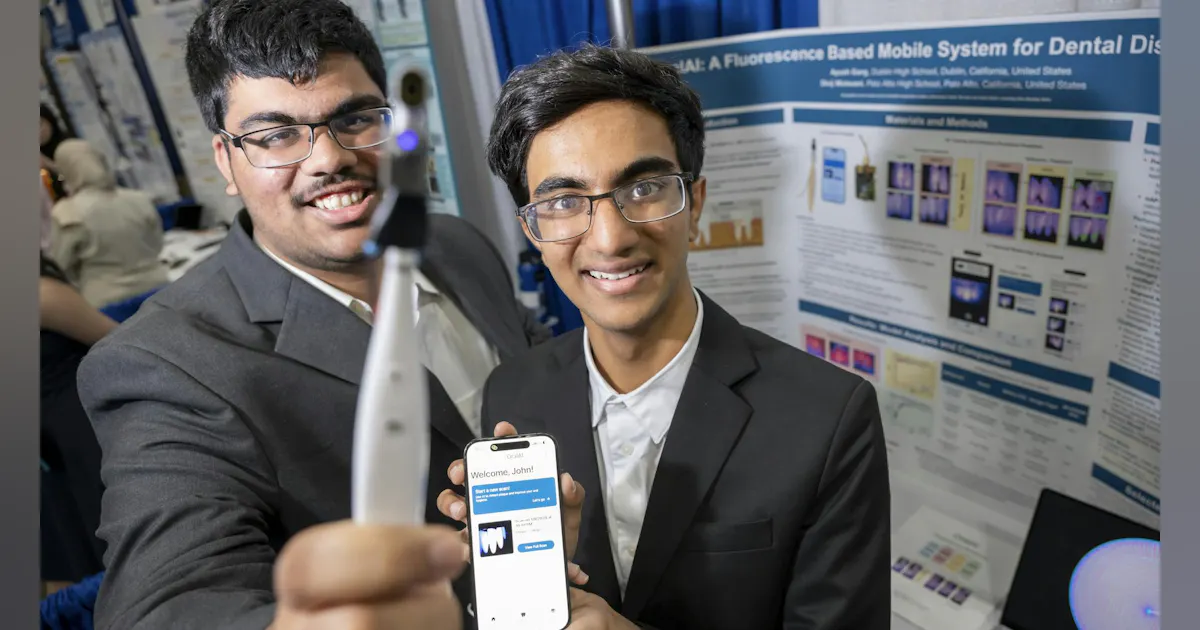
OralAI in the creators’ words
DentistryIQ: How did you test the device?
Ayush & Divij: OralAI’s image segmentation models were trained on over 200 images of our own teeth. To preprocess these images, we manually segmented out every instance of the biofluorescence that was created when excess bacteria was present, creating about 1,000 custom masks.
To test these models, we used general AI testing criteria by training and validating the model on 90% of the images, and then testing accuracy on the last 10%. This yielded accuracies with a precision of 98.4% for teeth extraction (separating teeth shape from gums) and 93.4% for plaque identification (determining location of likely plaque/hardened plaque formation). In addition to quantitative testing, we also used the entire full stack application from start to finish on our own teeth to make sure that it worked as expected.
DIQ: Where do the results go?
A&D: When a user completes a scan, these images are securely stored in the cloud through Amazon AWS S3 and MongoDB and processed with our AI models using Amazon AWS cloud. Once processed, the scan results are securely stored in the cloud and can be accessed by the user.
In the future, OralAI also has set up connections so that a user can add a dental care professional to their account for weekly dental monitoring. With this system, dentists can call someone when they need a professional cleaning, or when cavities begin to form. The user can track their oral hygiene over time, using the “Plaque Area %” metric, which measures how much of their teeth is covered by plaque per scan.
DIQ: How does someone follow up with their results?
A&D: Once a user has results, they can use them to better target their brushing and flossing by locating areas where there is negligent oral care. The app stores exactly what teeth are pictured in each image, so the user can easily see where exactly they’re missing brushing. If bacteria have accumulated to the point where calculus has formed, OralAI can inform users to schedule a professional dental cleaning.
DIQ: What has been the reaction of dental professionals to OralAI?
A&D: All the dental professionals who have seen OralAI so far have given us very positive reactions. Before ISEF, we talked to six dentists to validate our solution, and they all confirmed that our data looked good, and that the UV-A fluorescent biomarker was a reliable way to find calculus buildups. We also talked to some ISEF judges who are dentists, and they liked our product!
DIQ: What are your next steps? Do you have plans to distribute OralAI yet?
A&D: We’re currently working on securing more mentorship from large dental companies who could provide us the support and resources to scale our product and possibly integrate into existing consumer dental infrastructure, for example, putting OralAI imaging hardware into the brush head of a smart electric toothbrush. We plan to focus on research and development so we can improve our dataset, which currently is based only on our teeth. We’re also working on obtaining a patent for OralAI.
Having seen how important good oral health is firsthand, Divij and Ayush would love to have an impact on the overall health of the world with OralAI, an impressive goal for two California teenagers. They hope to develop OralAI to a point where it reaches people in rural areas and developing countries, who often historically lack consistent access to dental care.
But don’t look for the ISEF winners to join the dental profession when they enter the working world. They have their sights set on becoming engineers, with a focus on computer science, Al, and loT systems. They hope to use their knowledge in these fields to help solve problems in health and biology, which of course, includes oral health. Dentists and consumers can join the waitlist now by visiting OralAI.
link