



RALEIGH, N.C. — Everyone has heard that eating right and exercising are important for a healthy lifestyle, but a new study, including Duke University professor of evolutionary anthropology and global health Herman Pontzer, finds diet is the driving force behind obesity in industrialized civilizations.
What You Need To Know
- A new study finds diet to be the main cause of obesity
- Our bodies burn calories and energy naturally, and the expenditure tends to be the same despite exercise
- Herman Pontzer, a professor at Duke University, helped with the study and recently published a book titled “Adaptable: How Your Unique Body Really Works and Why Our Biology Unites Us” that touches on the subject
- According to the Centers for Disease Control and Prevention, 34% of North Carolinians are obese
Potato chips, candy bars and cheeseburgers are all tasty treats, and there is a reason for that. Salt, preservatives, sugars and fat all make a party of flavors and sensations in your mouth but can lead to overeating.
“Populations that have more of those ultra-processed foods as their diet tend to put on more weight and have a bigger issue with obesity,” Pontzer said.
Pontzer took part in a global study titled “Energy expenditure and obesity across the economic spectrum,” posted on the website of the Proceedings of the Natural Academy of Sciences, with findings that go against what many have been taught since elementary school.
“Almost all of the obesity crisis can be blamed on our diets. Over 90% of it, by our estimation. And we learned that by measuring energy expenditures, across a bunch of populations around the world,” Pontzer said. “What we found is, no matter what your lifestyle is, you pretty much have the same daily energy expenditure, even if you’re more physically active or less physically active.”
He says being more active isn’t “moving the needle” of energy expenditure, leading his findings to point to the energy we are eating.
Depending on your height and gender, your body will typically burn 1,300 to 2,000 calories naturally, according to the Cleveland Health Clinic.
“Our diets that are pushing some of us in some countries to be more obese, particularly here in the United States,” Pontzer said.

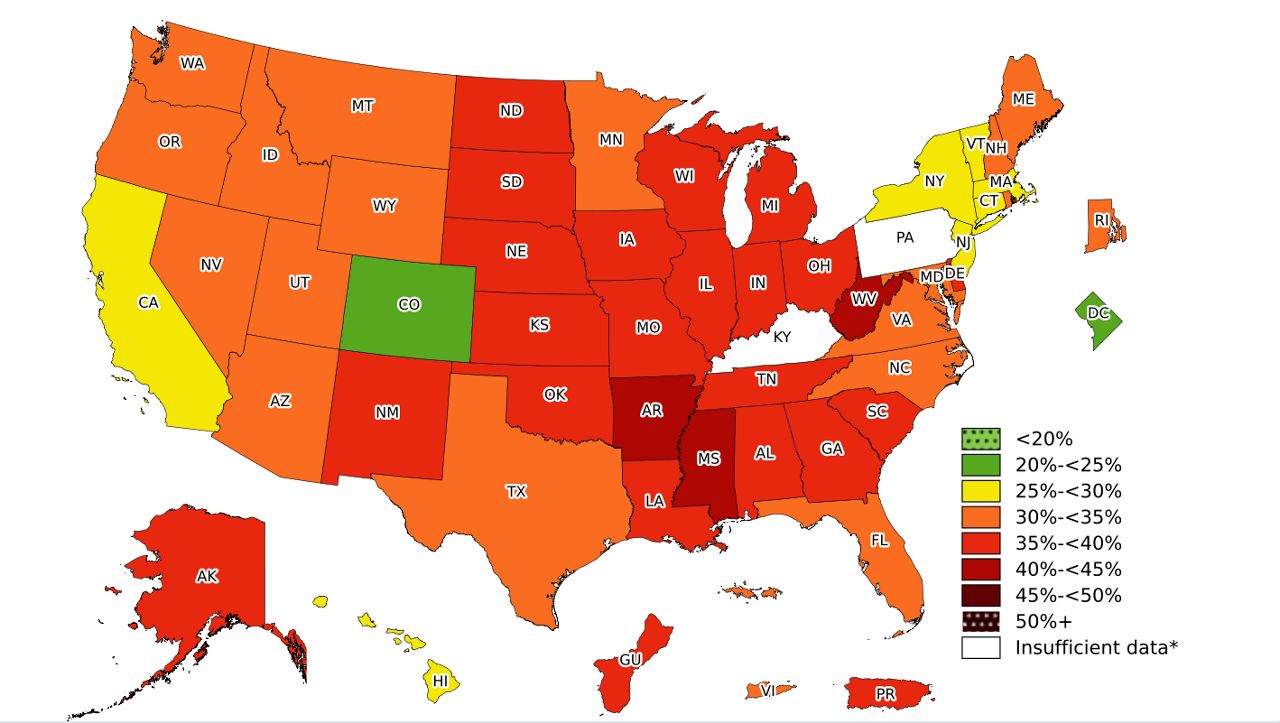
Map of obesity in the United States in 2023. (Centers for Disease Control and Prevention)
The Centers for Disease Control and Prevention reports as of 2023, more than one in five adults in the U.S. and its territories had obesity, including 34% of North Carolinians. These rates have continued to rise over the decades, tripling from the 1960s to the 2010s.
“They are engineering these foods to be delicious, of course, and to be hard to put down… when we’re not able to regulate how much we’re eating because it’s pushing our brains to sort of reward us too much when we eat these foods. I think that’s a big part of the problem,” Pontzer said.
He says we need to rethink how we engineer food in the future and how our brain thinks of eating healthy food.
“We can personally focus on those kinds of foods when we fill our supermarket, our shopping carts and supermarket and, you know, try to avoid ultra-processed foods that way,” Pontzer said.
He suggests eating food high in fiber and protein.
In a recent report, the U.S. Department of Agriculture says it expects fresh vegetable prices to decrease by 2% in 2025, and sugary sweet food prices to increase over 5%.
“A lot of the calories that are available in supermarkets are also making us healthier. You need enough calories to live a healthy life. So that part of it’s good, getting food, everywhere,” Pontzer said. “We haven’t done as good of a job in making sure those foods are promoting health and keeping us at a healthy weight, so we need to refocus on that.”
Gym culture, especially on apps like TikTok and Instagram, has become popular. Pontzer said while exercising is important, it’s not a good weight loss strategy.
“Focus on diet for your weight and focus on exercise for everything else,” Pontzer said.
Pontzer recently released the book “Adaptable: How Your Unique Body Really Works and Why Our Biology Unites Us,” which touches on issues discussed in the study.
link